
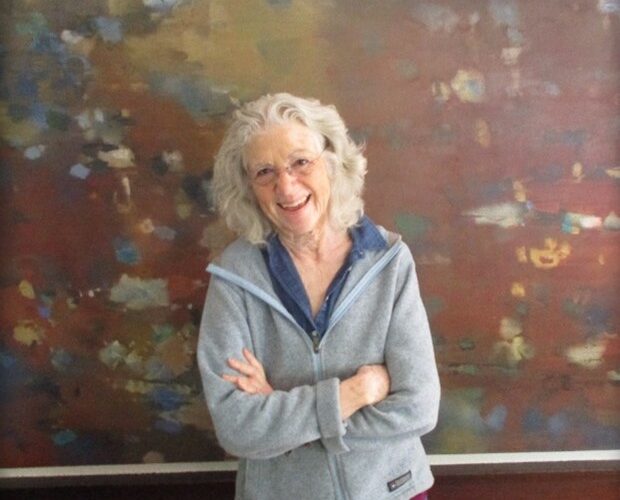
On April 18, 2026, the Susan Orr Memorial Garden at SDC was formally dedicated in an event attended by Susan’s family and friends. The centerpiece of the garden, a statue of the bodhisattva of compassion Quan Yin, had its eyes “opened” in a special ceremony.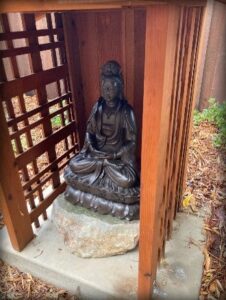
Susan Orr, who passed away in September 2018, was instrumental in the process of finding and acquiring the building and grounds that we have enjoyed since 2016.
On the occasion of the opening of the garden dedicated to her memory (and to introduce Susan to those who might not have known her) we are reprinting an article about her (below) from the May 2018 SDC News.
And next time you are at the Center, step outside to visit the garden (located near the northeast corner of the building). Take a moment to sit before the Quan Yin shrine and admire the beauty of the plants and natural stones of the landscaping.
(This article originally appeared in the May 2018 SDC News)
What can be said, but that Susan is a gifted leader? She guided the board through good times and bad, with optimism, good humor, and wisdom. She is a listener, a peacemaker, a finder of the middle way. Despite health challenges, she is indefatigable. She seems to dwell close to the spiritual but is practical and funny too. Board duty, she stresses, is inseparable from her practice and she believes that aggravation and setbacks are opportunities for practice.
 For Susan, the call for a Dharma center came in February 2009 over breakfast at a café on 10th Street. Jim Hare of Valley Streams Zen Sangha (VSZS) asked if she was interested in a project to acquire a permanent home, a Dharma Center, for the three Sacramento sanghas that shared common roots—Sacramento Buddhist Meditation Group (SBMG), Sacramento Insight Meditation Group (SIM), and VSZS. The idea had come to Jim during a January intensive Zen retreat, and Susan, an SBMG leader, was the first person he approached about its feasibility. After many such breakfasts and lunches with other leaders, the Inter-Sangha Coordinating Committee (ISCC) was formed in the spring of 2010.
The ISCC worked for two years laying the groundwork for SDC, recruiting board members and obtaining non-profit status. In March 2012 the SDC Board met for the first time, with Susan as a representative for SBMG (and later, an at-large member). The new board began the hard work of fundraising to prove to lending institutions the financial viability of the project. It also began to create SDC’s administrative infrastructure–Susan was part of the committees that wrote the bylaws and the SDC mission statement.
But front and center always was the search for a suitable property. Following up on every lead, and touring and evaluating each prospective building was not easy. Every building they debated and rejected, or pursued and lost, created a cycle of raised and dashed hopes. The lowest point came when the board decided not to buy the former Armenian church on B Street. “It was really awful,” Susan recalled. “Peoples’ spirits became despondent. But even then, there was the deeper urge to keep going, to not give up.”
Susan became SDC’s second president in March of 2015 at an opportune time. “I lucked out to be, timing wise, president just as we found the property.” In January of 2016 the board took a chance and made an offer to buy a former credit union building and land on Wissemann Drive, on the eastern edge of Sacramento. So began an intense period of negotiations, inspections, loan approval, acquisition of permits, and construction.
By the time of the SDC Dedication on November 6, 2016, it was apparent that along with pride, ownership of a building would bring with it a completely new set of challenges. For one, Susan discovered that “owning a property meant a mysterious sprinkler system. We found out how to practice with a continually mysterious sprinkler system.” The difficulties, she says, are what her teacher, James Baraz, calls “your curriculum.”
Her most significant achievement on the SDC Board was “helping people find ways to work together for the mission, to let go of fixed ideas and personality issues to the degree they could.” In fact, Susan’s secret goal is to see a Dantesque banner over the entrance to the building reading, “Abandon all preferences, ye who enter here.”
She stresses the centrality of “process,” a word that she invests with great meaning. Process is being patient–“There’s so much enthusiasm to get stuff done, but process is important, so things endure.” Process is how SDC found the right property, one that the sanghas would be able to expand into, rather than one that felt cramped at the start. And someday, she says, “We’ll expand into the space and it’ll feel not big enough. This is just the beginning of something that will keep evolving.”
Based on her experience on the SBMG and SDC Boards, she feels assured that SDC will continue: “People want access to the Dharma, and when it looks threatened, people rally ‘round. With the team approach to governance, the community won’t let something like this fail.”
In the future she plans to stay involved with SDC and keep “butting in” when necessary. She is hoping to be part of an independent SDC Ethics and Reconciliation Council for when big issues come up within sanghas or between sanghas and SDC.
In parting she added, “The best gift to my practice has been to be fully engaged with my sangha’s life and my Dharma Center’s life. So come on in, step up and do something. It won’t continue without people participating.”
BACK TO NEWS & EVENTS